
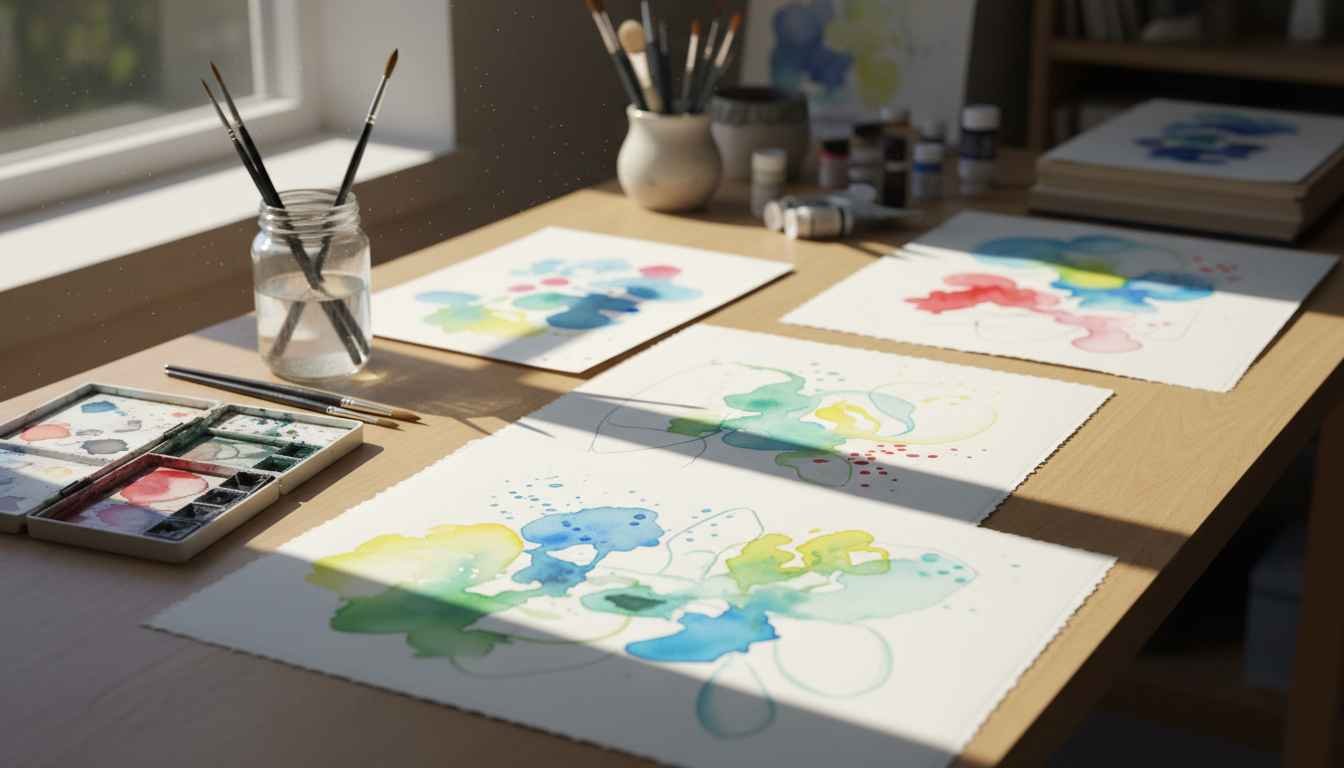
Have you ever felt like a blank page is both a promise and a challenge, a quiet canvas waiting for your touch yet intimidating in its emptiness? In the world of watercolor painting, sketches serve as the delicate bridge between imagination and reality, a whisper of form before the flood of color. They are the skeletons of dreams, subtle lines that guide the dance of pigment and water.
Walking into the sunlight-drenched studio, the faint scent of paper and pigments fills the air. Each sketchbook carries a world of possibilities, a visual diary of ideas that may never fully materialize yet exist vibrantly in the act of creation. Minimalist watercolor artists often start with the simplest forms: a single leaf, the contour of a mountain, or the curve of a bird in flight. These sketches are not mere outlines; they are the first breaths of a painting, a quiet conversation between hand and mind.
Sketching for watercolor painting demands patience. The lines must be light, almost hesitant, allowing the brush to take center stage when the paint arrives. Pencil hardness plays a crucial role, with H-grade pencils preferred for their subtle marks that do not interfere with the transparency of the watercolor. The process itself is a meditation, a way to slow down and observe, letting the world reveal itself in shapes and shadows. For inspiration and examples from industry professionals, artists often turn to resources such as Logo Design Magazine to study both technique and conceptual approach.
Step-by-Step Flowchart for Effective Watercolor Sketches
Step 1: Observation – Begin with a quiet look at your subject, noting the contours and proportions.
Step 2: Light Outlining – Use a soft pencil to capture the primary shapes, avoiding excessive detail.
Step 3: Refinement – Gently define secondary elements, ensuring lines remain faint and fluid.
Step 4: Composition Check – Step back and review your sketch, adjusting scale and balance as needed.
Step 5: Ink Optional – For a minimalist edge, consider very light ink lines to enhance depth before painting.
Step 6: Transfer to Watercolor – Prepare your watercolor paper and lightly transfer or redraw sketch, maintaining subtlety.
The Poetry of Minimalist Sketching
There is a quiet elegance in restraint. The fewer the lines, the more room the watercolor has to breathe. Minimalist sketches do not aim to capture every detail; instead, they suggest, hint, and evoke. A single curved stroke can imply the sway of a tree branch, while a faint arc may suggest a distant hill. In this interplay of suggestion and color, the sketch becomes both foundation and collaborator, leading the hand without constraining it.
Light is essential. Sketches should anticipate the washes of watercolor, leaving spaces untouched where the pigment will naturally pool and flow. Artists often use tracing techniques or light grid references to maintain proportion without heavy, intrusive lines. The goal is harmony between the graphite’s subtle guidance and the watercolor’s organic unpredictability. Following this approach ensures that each painting retains freshness and spontaneity, hallmarks of minimalist watercolors cherished in contemporary art circles.
Potential Drawbacks and Who Should Avoid This
Sketching for watercolor painting may not suit everyone. Artists who prefer bold, immediate color application or rely heavily on detailed, pre-determined plans may find this approach frustrating. Minimalist sketches require patience and acceptance of imperfection, which can feel restrictive for some. Additionally, overthinking or excessive sketching can lead to stiffness in the final watercolor, counteracting the fluidity that makes this medium magical. It is best suited for those willing to embrace subtlety and see beauty in simplicity.
Tools of the Trade
While simplicity is the guiding principle, having the right tools enhances the process. High-quality sketchbooks with smooth, cold-pressed paper provide an ideal base. Pencils should range from H to 2H for light lines, with erasers that leave no residue. Optional fine liners or light ink pens can add depth without overpowering the composition. Brushes vary according to style but soft sable or synthetic rounds often work best for the gentle washes that minimalist sketches anticipate.
Final Thoughts on the Art of Sketching
Sketches for watercolor painting are much more than preliminary drawings; they are intimate conversations with the medium. Each line is a note in a visual poem, a guide for color and movement that will emerge when water meets pigment. By embracing simplicity, paying attention to light and form, and approaching each sketch as a quiet meditation, artists cultivate a practice that is as rewarding as it is beautiful. In a world that celebrates speed and complexity, these sketches remind us that minimalism and patience are powerful tools for artistic expression.