
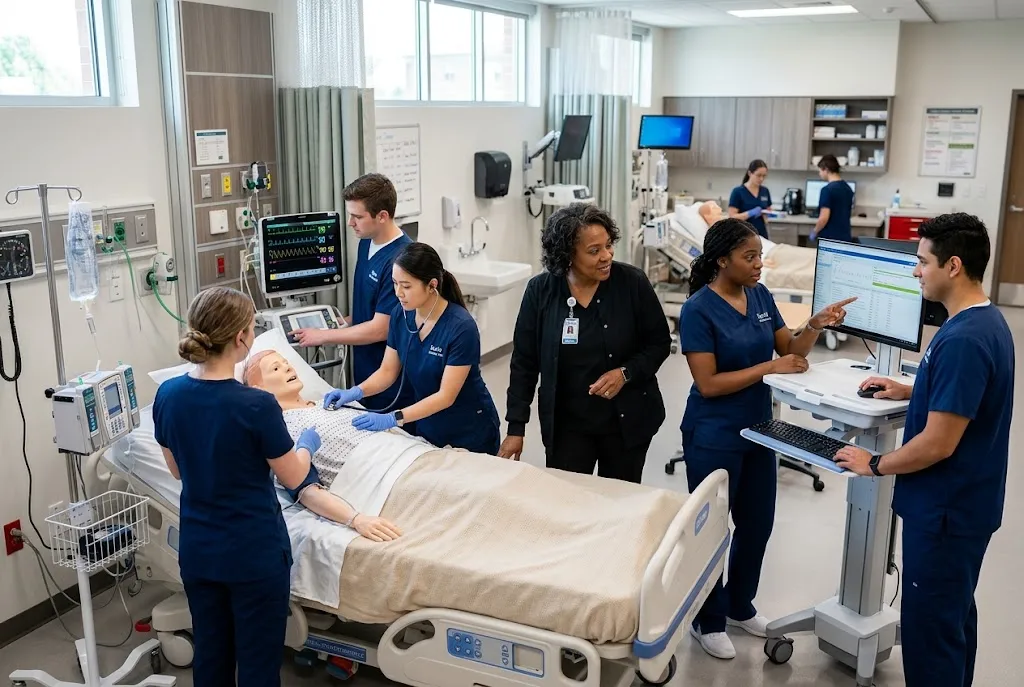
Nursing education requires students to develop both theoretical knowledge and practical skills. While lectures and textbooks provide important foundations, students also need opportunities to apply what they learn in realistic situations.
Nursing simulation provides a controlled environment where learners can practice patient assessment, communication, decision-making, teamwork, and documentation before working with real patients.
Technology has expanded what nursing simulation can offer. Digital patient records, simulated EHR platforms, online scenarios, and other educational tools can help connect clinical activities with the digital workflows students will encounter in modern healthcare.
What Is Nursing Simulation?
Nursing simulation uses realistic scenarios to help students practice healthcare skills in a safe educational environment.
Depending on the program, a simulation may involve:
- Patient assessment
- Clinical decision-making
- Communication
- Teamwork
- Patient-care planning
- Documentation
- Electronic health records
The goal is to provide students with an opportunity to apply knowledge rather than simply memorize information.
Why Simulation Is Valuable for Nursing Students
Nursing students eventually have to make decisions in situations where several pieces of information may need to be considered at once.
Simulation can help them practice this process before entering real clinical environments.
Students can work through a scenario, identify relevant information, make decisions, and receive feedback from instructors.
Because the environment is controlled, students can learn from mistakes without exposing real patients to unnecessary risk.
1. Connect Classroom Knowledge With Practice
One of the biggest advantages of simulation is the connection between theory and practical application.
A student may learn about a particular condition during a lecture. During simulation, that knowledge can become part of a patient scenario.
The student may then need to review information, assess the simulated patient, communicate with other learners, and determine appropriate next steps.
This makes learning more active.
2. Use Realistic Patient Scenarios
Effective simulations should be connected to the student’s level and learning objectives.
A simulated record can include information such as:
- Patient history
- Vital signs
- Allergies
- Medications
- Clinical notes
- Assessment findings
Students can use this information to understand the situation and determine what information is relevant.
The scenarios do not need to reproduce every aspect of a hospital environment. They simply need to provide enough realistic context to support the educational objective.
3. Include Digital Documentation
Electronic documentation is an important part of modern healthcare.
Nursing students may benefit from practicing documentation alongside clinical simulation instead of learning these skills separately.
An educational EHR can allow students to work with simulated patient records and document information based on a scenario.
This can help students understand the connection between clinical activity and digital records.
4. Develop Clinical Reasoning
Simulation can encourage students to think through situations instead of simply recalling information.
A scenario may require a learner to determine:
- What information is most important?
- What should be assessed?
- What changes should be recognized?
- What should be documented?
- What information should be communicated?
These activities can support the development of clinical reasoning.
5. Practice Communication
Communication is another important part of nursing education.
Some simulation activities can involve several students working together.
Learners may need to communicate patient information, explain their observations, discuss decisions, or coordinate tasks.
This provides an opportunity to practice professional communication in a controlled setting.
6. Learn From Mistakes
Students should have opportunities to make mistakes during education because mistakes can reveal areas that require additional learning.
Simulation provides a safe environment for this.
If a student misses an important detail or documents information incorrectly, the instructor can use the situation as a teaching opportunity.
The student can understand what went wrong and practice the correct approach.
7. Give Students Instructor Feedback
Feedback is an important part of the simulation process.
After an activity, instructors can discuss:
- What went well
- Which information was missed
- How decisions were made
- Whether documentation was appropriate
- What should be practiced again
This discussion can help students reflect on their performance and improve future attempts.
8. Support Different Levels of Learners
Not all nursing students need the same type of simulation.
Beginning students may benefit from straightforward scenarios focused on basic skills.
More advanced students can work through scenarios involving multiple conditions, complex patient information, or more detailed documentation.
A flexible simulation approach allows educators to increase difficulty as students progress.
9. Combine Simulation With an Educational EHR
An educational EHR can make a simulation more comprehensive.
Students could begin by reviewing a simulated patient’s record, participate in a scenario, and then document relevant information afterward.
This creates a workflow such as:
Review → Assess → Respond → Document → Reflect
This approach can help students understand how clinical decisions and electronic documentation are connected.
10. Evaluate Technology Carefully
Technology can improve simulation, but educators should choose tools based on educational requirements.
Before adopting a platform, consider:
- Curriculum compatibility
- Scenario quality
- Student usability
- Instructor controls
- Documentation features
- Accessibility
- Technical support
- Pricing
- Scalability
A tool should support the simulation rather than distract students from the learning objective.
How Digital Tools Can Extend Simulation
Technology can allow some learning activities to continue outside the physical simulation lab.
For example, students may be able to review simulated patient records, complete documentation exercises, or revisit scenarios as part of independent study.
This can be especially useful for students who need additional practice.
However, digital activities should remain connected to the broader curriculum and instructor guidance.
ChartFlow and Nursing Education
Healthcare education programs looking to incorporate digital tools into nursing simulation can consider educational EHR platforms.
ChartFlow provides a simulated EHR environment designed for healthcare education. Students can work with simulated patient scenarios and practice electronic documentation as part of their learning.
This type of resource can complement traditional simulation by adding a digital documentation component.
Students can also explore the ChartFlow course catalog, which includes educational resources designed for healthcare learners.
Questions Nursing Educators Should Ask
Before selecting a simulation technology, educators can ask:
- Does it support our nursing curriculum?
- Are the patient scenarios realistic?
- Can students practice documentation?
- Does it support electronic health records?
- Can instructors create activities?
- Can faculty review student work?
- Can difficulty be adjusted for different learners?
- Can students access activities outside the simulation lab?
- Is the technology easy to use?
- Can the platform scale with the program?
These questions can help educators evaluate solutions according to actual teaching needs.
Common Mistakes to Avoid
One mistake is choosing technology because it has a large number of features.
More features do not necessarily produce better learning. The technology should support the specific skills students need to develop.
Another mistake is separating documentation from clinical learning completely.
When appropriate, integrating digital documentation into simulation can create a more complete representation of modern healthcare workflows.
Educators should also avoid making simulations unnecessarily complicated. A clear learning objective should guide the scenario.
Building an Effective Simulation Activity
A useful simulation can begin with one clear objective.
For example:
Objective: Students will practice reviewing patient information and documenting relevant findings.
The instructor can then create a simulated patient scenario around that objective.
Students review the record, participate in the activity, document their observations, and receive feedback.
This approach keeps the focus on learning rather than technology.
Final Thoughts
Nursing simulation can provide students with valuable opportunities to apply classroom knowledge in realistic but controlled environments.
When digital tools and educational EHR platforms are incorporated appropriately, students can also develop familiarity with electronic documentation and digital patient records.
The strongest simulation programs focus on clear objectives, realistic scenarios, instructor feedback, and appropriate technology.
For nursing educators, the goal should not simply be to add technology to the curriculum. It should be to create learning experiences that help students develop the clinical, communication, reasoning, and documentation skills they will need in modern healthcare.